Research · August 2026
The benchmark says your voice AI speaks Latvian. The phone line disagrees.
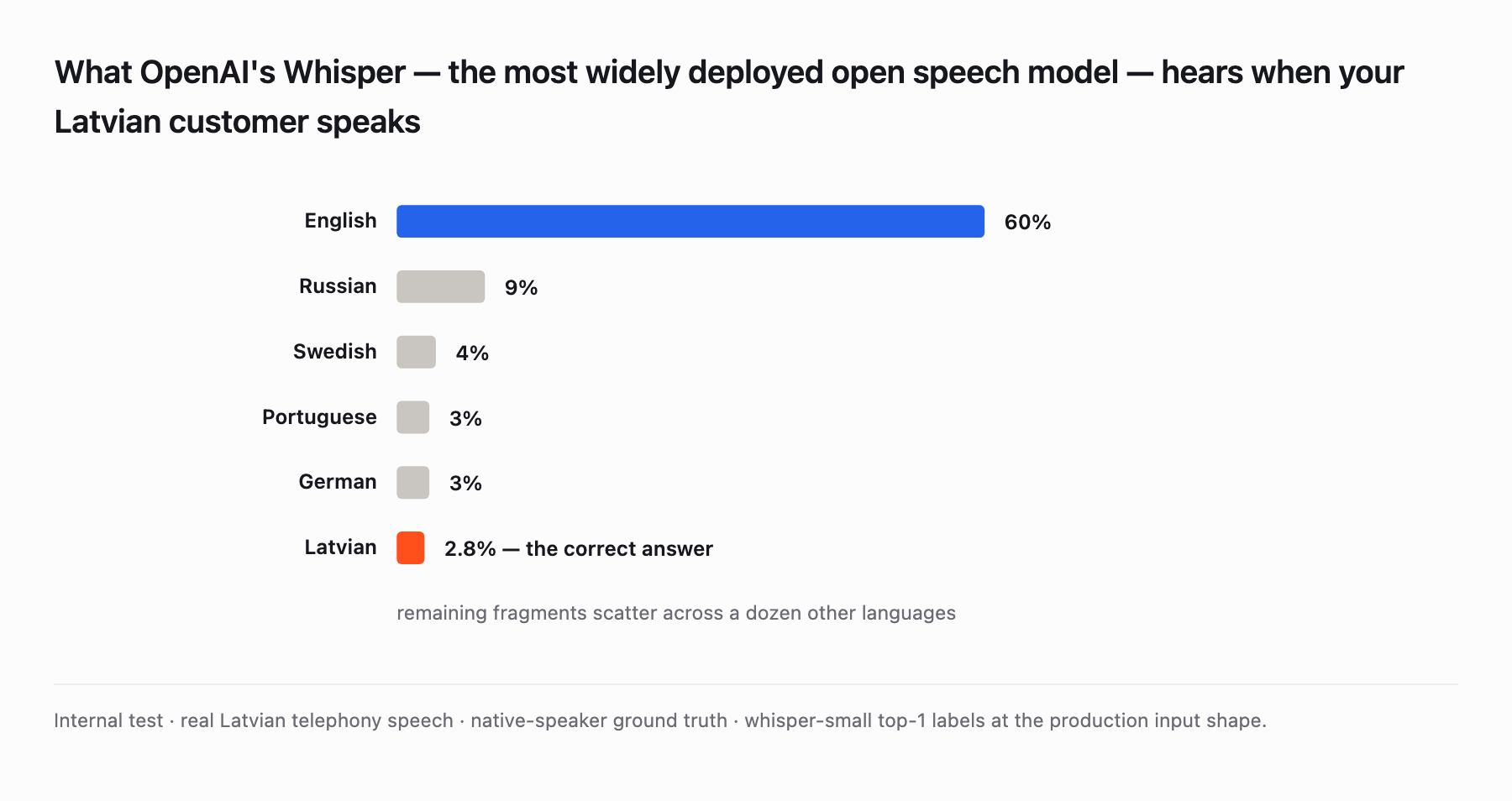
A customer picks up, says labdien, and the model listening decides it just heard English — on 60% of real Latvian phone speech in our internal tests, from OpenAI's Whisper, the most widely deployed open speech model, against ground truth labelled by native speakers. The standard synthetic evaluation didn't just inflate the numbers; it picked the worst model on our board as the best one.
What OpenAI's Whisper — the most widely deployed open speech model — hears when your Latvian customer speaks
Internal test · real Latvian telephony speech · native-speaker ground truth · whisper-small top-1 labels at the production input shape.
Vitālijs Silins-Ozerson LinkedIn
CTO & co-founder · 14 August 2026
This is the first of two Convershake research articles. It measures the problem: what the speech models on the shelf actually hear on a real Latvian phone line. The second shows what we trained to fix it — publishing soon.
Language is where voice-AI adoption gets judged
On a regulated line everything has to be right — the numbers, the dates, the disclosures. Language decides whether the customer even gets to hear them. An agent that answers a Latvian-speaking customer in Russian, or strands a Russian speaker in Latvian until they hang up, has failed before the first digit is read, audibly, on a recorded line. And in Latvia the language of service is law: the Official Language Law requires private companies to use the state language where their activities touch legitimate public interests, consumer-rights protection among them. That obligation is becoming more explicit: amendments to the Consumer Rights Protection Law now before the Saeima (bill 1064/Lp14) would set language-of-communication rules for consumer service directly in statute. If they pass, the language your agent answers a customer in stops being a matter of taste and becomes a matter of written consumer law — and whether a system can reliably tell which language it is hearing becomes a compliance property you may have to demonstrate, not a quality preference. Check current status and wording at those official sources, with your counsel; this piece is measurement, not legal advice.
Four callers, one decision, and stakes that are not symmetric
| The caller | What the system must do | Cost of the error |
|---|---|---|
| Speaks Latvian | never switch | A wrongful switch on a recorded line, in the market’s most sensitive direction — and in Latvia a matter the Official Language Law reaches. |
| Speaks Latvian with a Russian accent ≈ 1 in 5 of Latvian-speaking callers on the line we measured |
never switch — hardest case | The same wrongful switch, made systematically: this group is precisely what a “how Russian does it sound” score fires on. |
| Speaks Russian | switch, fast | Every turn before the switch is a reply the customer sits through in a language they did not choose — a cost that grows with detection latency. |
| Switches language mid-call | follow — once | Follow too slowly and it is the cost above; follow every noisy fragment and the agent ping-pongs between languages, which is worse than either. |
Internal test · the one quantified rate (≈1 in 5) measured on real calls from this line, accent judged blind by a native speaker — one line, one window. Group sizes are not implied: the corpus's language mix is enriched for evaluation, not a population share.
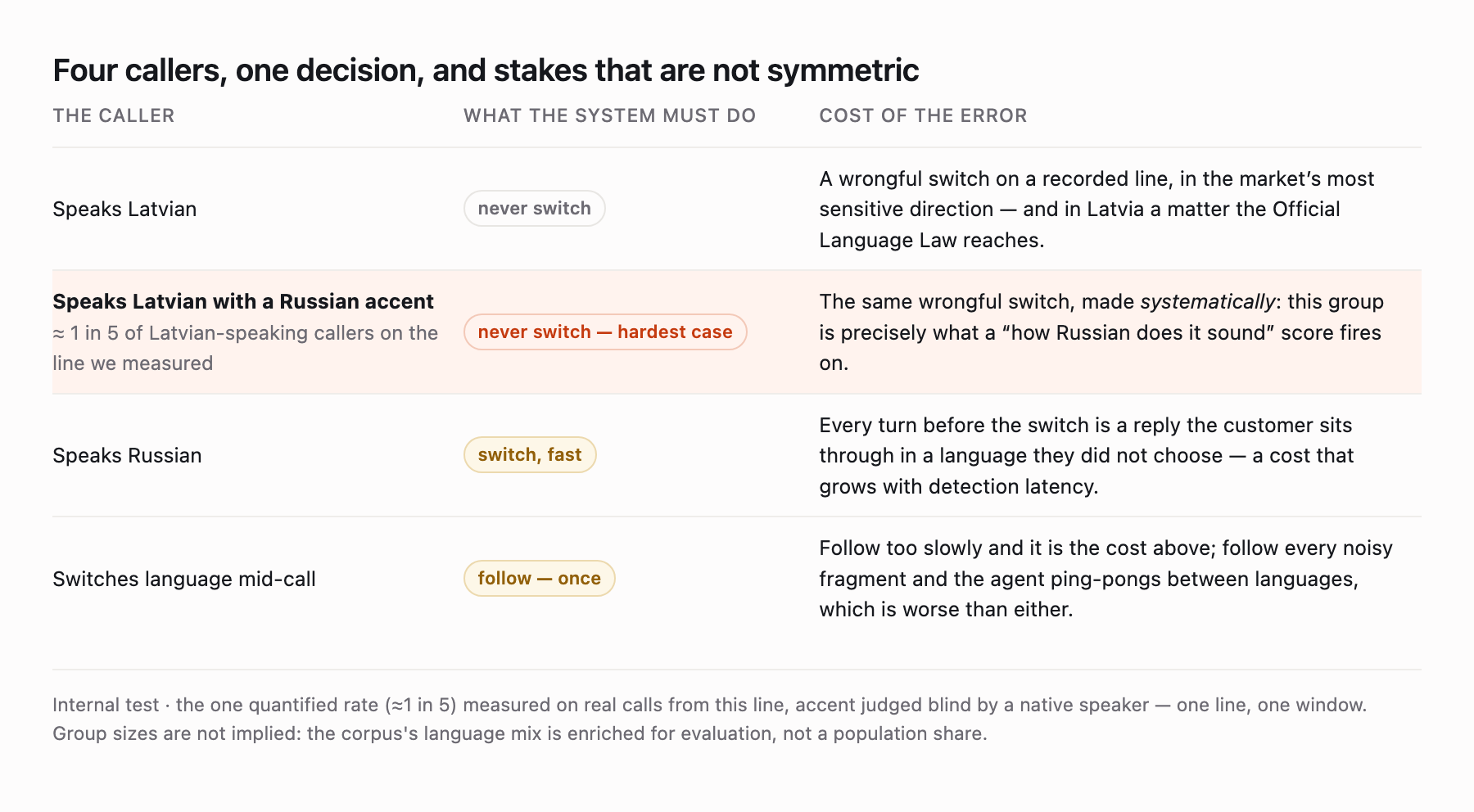
Look at the second row. On the line we measured, roughly one Latvian-speaking caller in five carries an audible Russian accent and keeps speaking Latvian. Those customers must never be switched — and they are exactly the callers a naive "sounds Russian" score switches, systematically. That asymmetry is why every accuracy number in this piece is measured at a strict ceiling on wrongful switches: recall only means something after the market's most sensitive error is pinned.
So when a vendor tells you "we support Latvian and Russian," the only question that matters is: measured how?
What the models actually hear
We took the open-weight speech models any vendor's stack can be built on — Whisper at small, medium and large-v3, and the dedicated spoken-language-ID models VoxLingua107 ECAPA, CommonLanguage ECAPA and MMS-LID — and fed every one the same fragments of real caller audio, with ground truth labelled by native speakers. Commercial cloud APIs are out of scope here; the corpus is internal, because real call audio cannot be published.
On real Latvian telephony speech, whisper-small — the tier of Whisper most stacks actually run — answered "English" on 60% of it. "Latvian" on 2.8%. The dedicated language-ID models scattered the same audio across Faroese, Waray and Basque. On this channel the Latvian hypothesis is effectively absent, and the model's language score degrades into a Russian-ness signal with nothing on the other side of the comparison.
This is not an accent problem: with accent labels made blind by a native speaker on the same internal test audio, the model wrongly flags un-accented and strongly accented Latvian at the same rate — 87.5% against 90.2%, a statistical tie. Nor is it a small-model problem you can size your way out of, as the next section shows.
What that leaves you to deploy
Held to the constraint a regulated line actually needs — almost never switch a Latvian-speaking customer by mistake — the model tier a live call can afford catches about one Russian-speaking caller in three. The dedicated language-ID models catch about one in five.
The bigger Whisper tiers do genuinely better, about one in two; an earlier draft of this work claimed "scaling up doesn't help," and the corrected measurement reverses that — we were wrong, and we are saying so rather than editing it away. But the better tiers cannot answer inside a live conversational turn: large-v3 needs over five seconds per fragment on a fast local machine, and even the affordable tier's worst case on a single real fragment was a thirty-second stall. Accuracy on this channel is buyable with compute, and a live call cannot spend it. The best detector on the table cannot be deployed.
With wrongful switches on Latvian capped, nothing deployable catches even half of Russian speech
| Model | Catches real Russian | Held-out false positives | Latency | Verdict |
|---|---|---|---|---|
| Whisper · large-v3 | 52% |
1.5% | 5.3 s | best — undeployable |
| Whisper · medium | 51% |
2.4% | 2.9 s | too slow |
| Whisper · small | 37% |
3.0% | 0.7 s | affordable — 1 in 3 |
| MMS-LID · 1B | 22% |
4.7% | 0.4 s | 1 in 5 |
| VoxLingua107 · spoken-LID | 20% |
2.4% | 22 ms | 1 in 5 |
| CommonLanguage · spoken-LID | 20% |
1.5% | 26 ms | 1 in 5 |
Internal test · real telephony audio · native-speaker ground truth · recall at a strict wrongful-switch ceiling, error rates from calls the thresholds never saw; latency per fragment, local hardware.
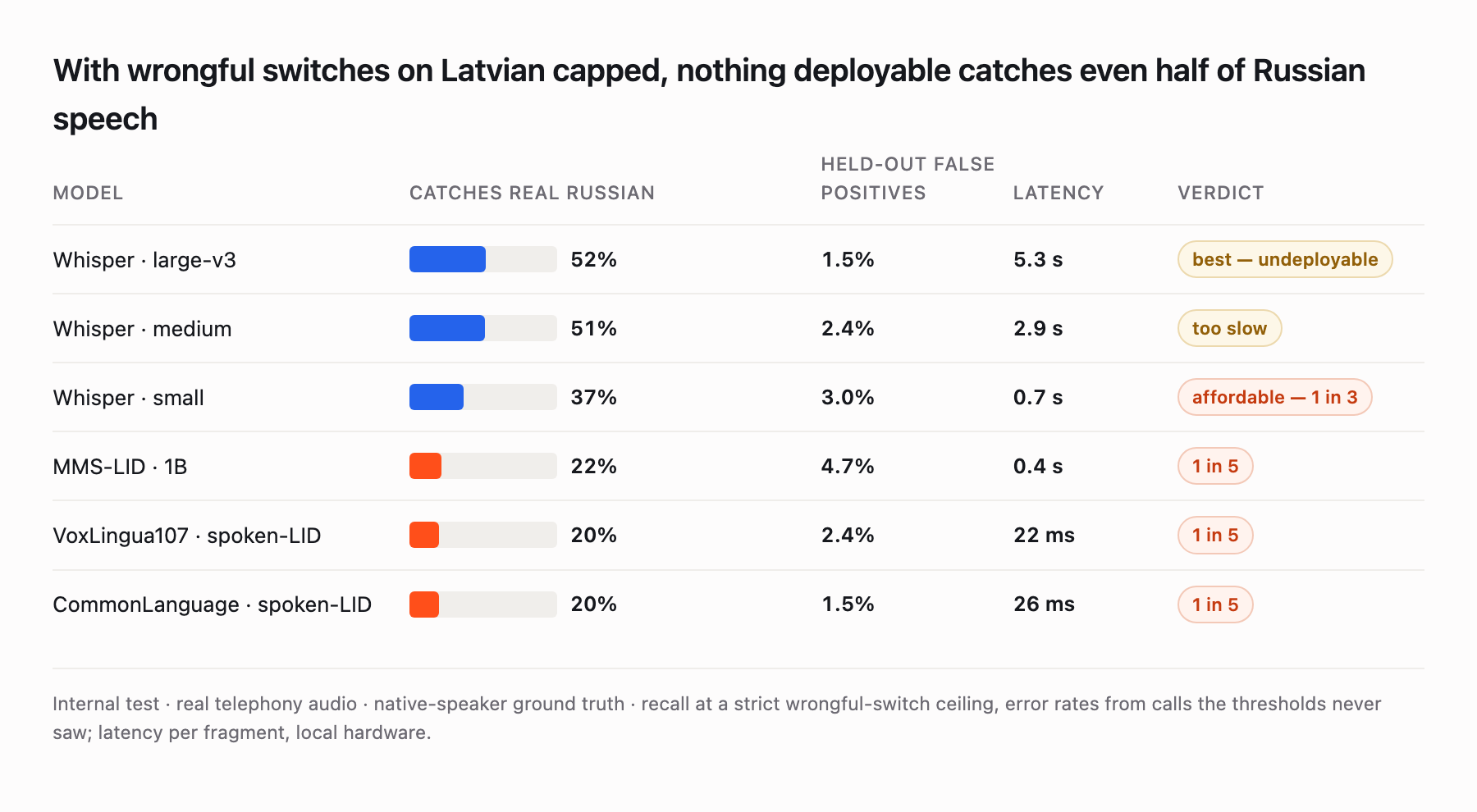
That is the real state of the shelf your vendors are building on. Whatever they have layered on top of it, this is the raw material — and it is the thing their evaluation should be showing you.
Latvia has its own speech models. The Institute of Mathematics and Computer Science at the University of Latvia — AiLab — publishes openly licensed Latvian speech models, AiLab-IMCS-UL/whisper-large-v3-lv-late-cv17 and AiLab-IMCS-UL/whisper-large-v3-lv-phono, and we scored both on the same instrument as everything above — they are the dashed lines in the lab-versus-real figure below. They are transcription models, built to transcribe Latvian and good at it — judging them as bilingual language detectors is measuring them at a job they never claimed, and that has to be said before anything else. And measured at that job anyway, they became the sharpest evidence in this piece: on clean synthetic audio they genuinely discriminate, and on a real phone line they answer "Latvian" to essentially everything, Russian included. The channel does that, not the models. The next figure shows what it does to a synthetic benchmark.
Why the evaluation you'll be shown won't show you this
The industry's standard evidence is synthetic: studio recordings resampled to 8 kHz through a telephony codec so they "sound like a phone," or a demo call made in a quiet office by a clear speaker. We built the synthetic test too, cut to the same fragment lengths as the real calls, and scored it identically — same models, same constraint.
Measured against real calls — the same internal test, the same native-speaker ground truth — the synthetic benchmark overstated every general model's performance by 2× to 4.6×. And the damage is not just inflation: the ordering flipped. The model that scored best on synthetic audio — 93%, the obvious procurement choice — was nearly the worst on real calls, at 20%. An adoption decision made on that benchmark selects the failing system and documents the diligence that selected it.
The evaluation you’ll be shown picks the model that fails your customers
Internal test · same scorer, same held-out ceiling; the synthetic slice is studio speech degraded to telephony and cut to the real slice's fragment lengths, so the two differ only in real versus synthetic speech. Dashed line: AiLab · lv-late-cv17, a Latvian transcriber measured at a detection job it never claimed; lv-phono shows the same shape at 23×.
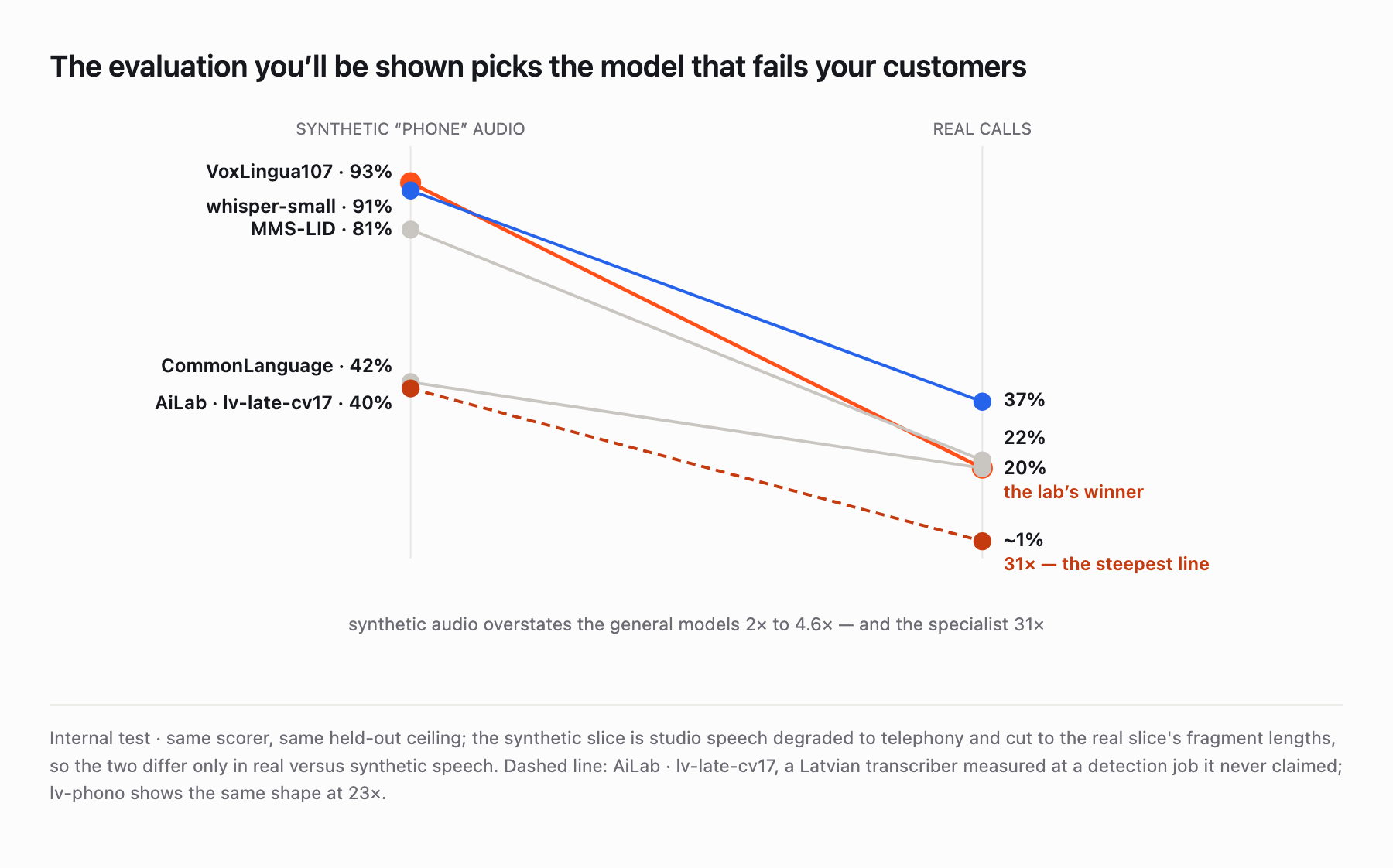
The AiLab models take the same effect to its extreme. On synthetic audio the stronger of the two, lv-late-cv17, reads as a plausible detector, catching two Russian speakers in five at the strict ceiling. On real calls it catches roughly one in seventy-five — a 31× overstatement. A team evaluating it on synthetic evidence would deploy a detector that almost never fires, and the benchmark would have called it reasonable.
One more result from our own process, because it generalises to any vendor number you are shown: when we first tuned each model's decision threshold and measured its error rate on the same recordings, every model passed the target by construction. Re-measured on calls the tuning had never seen, some missed it by more than double. A vendor's accuracy figure that does not say "measured on held-out audio" — audio the system was never tuned on — should be assumed not to be.
The questions buyers actually ask — and what to add to them
We sell voice AI in this market, so we hear the real evaluation questions weekly: from collections leads unifying five markets on one platform, from operations heads comparing partners on a deadline. They are good questions. The measurement above sharpens each one.
- Have you done our languages before — can I hear it?
- Always ask this, and be careful what the demo proves. A demo call is a quiet room and a clear speaker — exactly the audio this piece shows overstating every model by 2× to 4.6× and crowning the wrong one. Hear the demo, then ask for the measurement on real call audio from your market.
- What happens when a customer answers in Russian?
- The sharper form: ask for the distribution of what the detector actually decides on your callers, not for an accuracy number. On the shelf, the honest answer is "English, most of the time" — better heard in the evaluation than from your customers.
- And our Latvian speakers with a Russian accent?
- Anyone who has run a Baltic line knows these callers — a fifth of the Latvian speakers on the line we measured. The wrongful switch is the market's most sensitive error, and it is the built-in failure of every score that only measures how Russian something sounds.
- How natural is it — will people stay on the line?
- Naturalness is judged in the customer's language. The most fluent voice in the wrong language is the hang-up. Language first, voice second — and the language decision has to land inside a live turn, worst case included, which is what disqualified the most accurate models above.
- Where does that number come from?
- One habit worth stealing from our own process: an accuracy figure that does not say "held-out" — measured on calls the system was never tuned on — should be assumed tuned. Ours moved by up to 2.5× between the two.
A vendor with real measurements answers these in the meeting. A vendor with a benchmark slide asks to follow up.
What we're not claiming
An accent effect, in either direction — our strongly-accented sample is too small to prove one, and what it shows is a tie. A caller-population statistic: one line, one window. Anything about models adapted to a specific telephony channel — everything here tests the models exactly as they ship, and adaptation is a different measurement. Anything about commercial cloud APIs, which this piece deliberately does not cover. And any legal position: the regulatory picture above is context, current only as of writing, and belongs to the official sources and your counsel.
The measurements are Latvian and Russian, over the phone. The mechanism — a missing language hypothesis that synthetic audio hides — should concern any adoption leader whose market speaks a language thinly represented in web-scale training audio, which is most of Europe outside its five biggest languages. We will measure a second pair rather than assert it.
Since nothing on the shelf could hear this line, we trained a detector that can. Part two of this series is that build and its numbers: our own Latvian↔Russian model on this same board, and the detection workflow around it that catches 82% of Russian-speaking callers where the standard build catches 67%, at the same wrongful-switch rate, measured on a replay of real recorded calls.
Next in this series: the detector nobody sells — what we trained to hear this phone line, and what it catches. Publishing soon.
Evaluating voice AI for a bilingual market?
We will run this measurement on your own call audio and show you what any candidate stack actually hears — ours included.